Home

Chapter 1

  1. Introduction
  2. Bidding
  3. Evaluate Opening Bid
  4. Opening Bid Options
  5. Scoring Structure
  6. Bidding Strategy
  Statistics

Chapter 2:  Open 1 Level

Open 1 Level
   Open  1 ♠ 
   Open  1 ♥ 
       Open  1 NT 
           Open Better Minor
               Open  1 ♦ 
               Open  1 ♣ 
Opening Bid & Table Position

Chapter 3:  Respond 1 Suit Opening

   Guidelines for Responses
         Support Suit (Distribution Points)
         Propose Suit (1-over-1 Restriction)
  • Respond to  1 ♠ 
  • Respond to  1 ♥ 
        Use the  Jacoby 2 NT  response
  • Respond to  1 ♦ 
  • Respond to  1 ♣ 

Chapter 4:  Opener's Next Bid

Opener's Next Bid (Bid 3)
   after  1 ♠  Opening
   after  1 ♥  Opening
   after  1 ♦  Opening
   after  1 ♣  Opening
   after  Jacoby 2NT  Response

Chapter 5: Respond to 1 NT Opening

Respond to  1 NT 
    Transfers (1NT)
           5+Hearts 
           5+Spades 
    Stayman (1NT)
           2 ♦  No 4-card Major
           2 ♥  4-card Heart
           2 ♠  4-card Spade
    No 4+card Major (1NT)
         
 Balanced 
           6+Clubs 
           6+Diamonds 

Chapter 6 - Weak Openings

Weak Suit Opening Bids
 • 6-card suit            2 ♦   2 ♥   2 ♠ 
 • 7-card suit   3 ♣   3 ♦   3 ♥   3 ♠ 
 • 8-card suit                    4 ♥   4 ♠ 
-----------------------
Respond to Weak Suit Openings
  • Respond to          2 ♦   2 ♥   2 ♠ 
  • Respond to  3 ♣   3 ♦   3 ♥   3 ♠ 
  • Respond to                   4 ♥   4 ♠ 

Chapter 7 - Strong  2 ♣ 

Open  2 ♣ 
Respond to  2 ♣ 
  •  2 ♦ Waiting  (SAYC)
  • 3-Point Step (Social Bridge)

Chapter 8 - Open Strong  NT's 

Open  2 NT  or  3 NT 

Respond to  2 NT 
    Transfers (2NT)
    Stayman (2NT)
    No 4-card Major (2NT)
Respond to  3 NT 
    Transfers (3NT)
    Stayman (3NT)
    No 4-card Major (3NT)

Chapter 9 - Other Bids

 • Slam (Blackwood & Gerber)
 • Overcalls
 • Doubles
 • Balancing

Chapter 10 - Practice Bidding

Open 1 Level
Responses to 1 Suit Openings
Open  1 NT  (14 Examples)
Open  1 NT  (16 Examples)
Open Weak (17 examples)
Responses to  2 ♣  Opening
Overcalls

Practice Websites

   • SAYC Bidding Practice
   • Trickster
   • Bridge Base On Line

Chapter 11 - Taking Tricks

Leads on Defense
Leads on Offense
Finessing a Tenace

Chapter 12 - Duplicate Bridge

Equipment
Duplicate Protocol
Duplicate Scoring
1. Contract Points
2. Match Points

Download PDFs

01a-SAYC Summary Notes
01a-SAYC Mantra
02a-Open 1-Level
02b-Better Minor
03-Respond 1-Suit Opening
04-Bid 3 Tables
05-Respond 1 NT Opening
06-Respond Weak Opening
07-Respond 2 Club Opening
12-Duplicate Protocol
12-Duplicate Points Table

Home Page - Standard American Yellow Card (SAYC)

This website contains bidding concepts of a BEGINNER's version of Standard American Yellow Card (SAYC).

What is Standard American Yellow Card (SAYC) ?

History

By 1925 Contract Bridge, or just Bridge, was a popular entertainment card game in the US for avid card players and for people with time on their hands. This game evolved from whist and auction bridge.

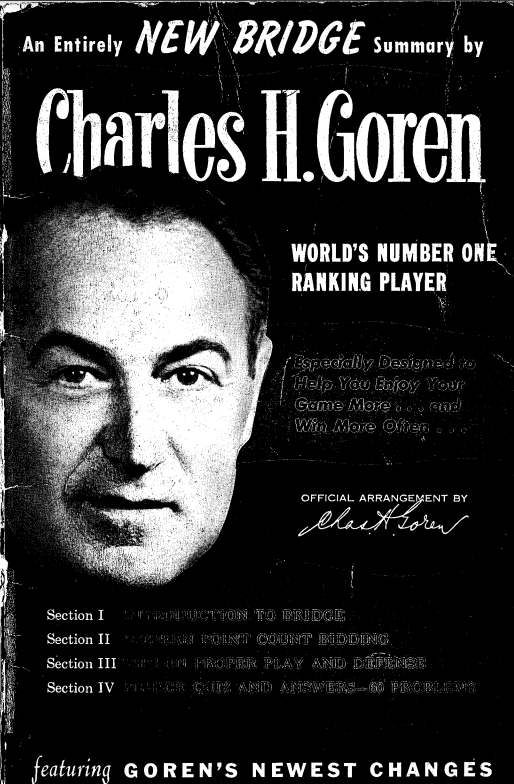
Many championship players added new concepts to the game as the game continued to evolve. One such player was Charles Goren, a domestic and international bridge champion who not only played, but was a widely read syndicated columnist and author on the game. With his merchandizing of bridge paraphernalia, he was the “guru” of Standard American Bridge in the US.

Most everyone learned to play bridge using the Goren style of bidding. This bidding system was characterized with opening 4-card majors and all 2-suit openings were strong. This was referred to as "Standard American".
1958Goren 1958
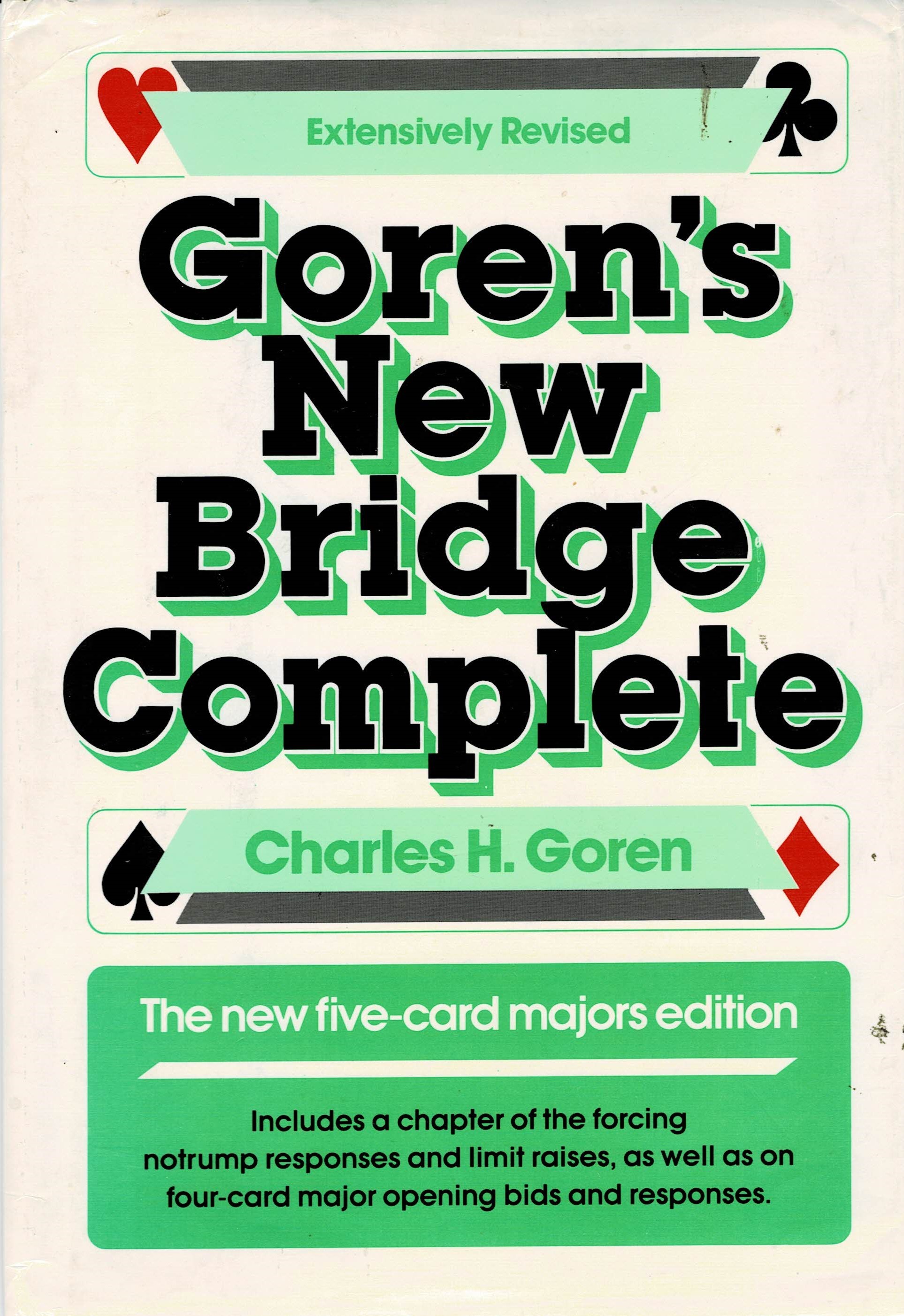
As all languages evolve over time, the Goren bidding language also evolved. By 1985, the bidding evolved to the use of 5-card majors to open, and weak 2's (opening a 6+card suit with less than opening count) were added to make the game more competitive. A 2-club opening was reserved for a strong opening in any suit. Goren published another book in 1985 preaching these evolved methods which became a common system of play, and was still referred to as "Standard American".

Competitive players and tournament players were well aware of this evolution. But many social players were not.
1985Goren 1985
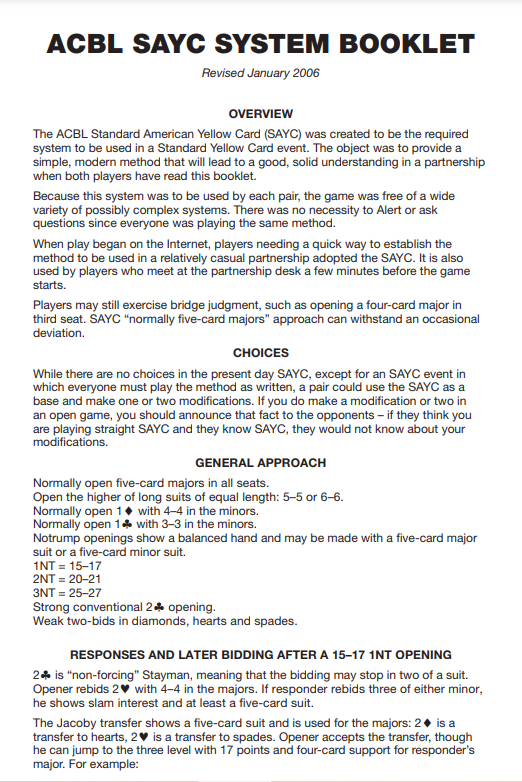
2006 ACBL
8-page bookletSAYC 2006 Download this booklet

The Birth of "Yellow Card"

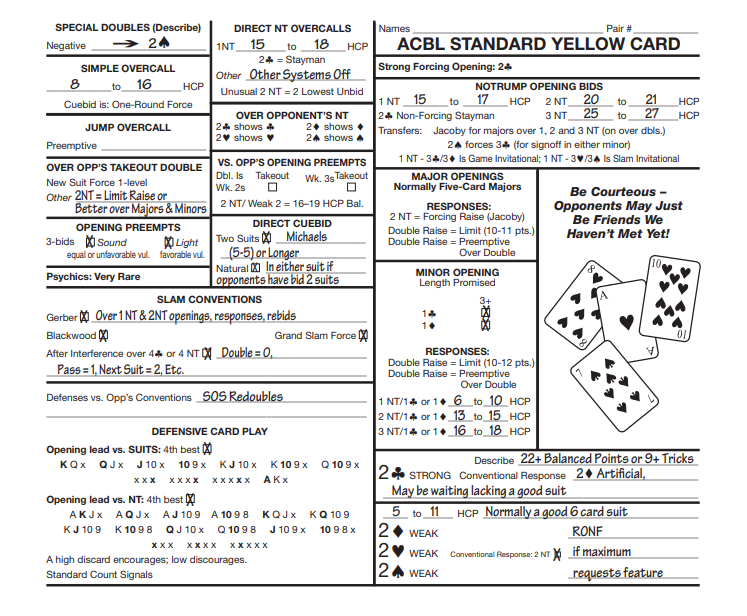
The Americal Contract Bridge League (ACBL) held many regional and national tournaments where each team had to provide a "convention card" describing the method of bidding they were using for viewing by their opponents and the tournament director. There were so many different bidding systems in use that the ACBL held some tournaments where the teams were only allowed to use the 1985 version of Goren Standard American. The ACBL printed convention cards on yellow card stock using the 1985 Goren style bidding. This bidding method and convention card became known as Standard American Yellow Card (SAYC).
Many social players today are using "Yellow Card" in social games, but are not aware that there is a name for this style of bidding.

SAYC ConventionCard SAYC Convention Card Download this convention card

General Approach

Bidding is like speaking in a foreign language. It has its own rules of grammar and syntax. Learning Yellow Card bidding is like learning a foreign language. It requires time and practice. You cannot learn this bidding system by looking over a player's shoulder and start playing in 20 minutes.
    • The beginner should follow the rules explicitly. The concepts are new and it will take time to learn them. So please, treat the rules as rules, and don't break them until after the beginner becomes an experienced player.
    • Bridge is a intricate game with many possible paths and outcomes. This web site will focus on the situations that will be encountered 80% of the time. There is enough to learn for these 80% situations, so do not worry about the infrequent or rare situations until after the beginner is comfortable with the 80% situations.

Standard American Yellow Card (SAYC) Bidding System Mantra

First

Determine which suit to play in the following priority:
1) Try for a MAJOR suit contract.
2) Try for a NO TRUMP contract.
3) As last resort, settle for a MINOR suit contract.

Second

After the suit is known, determine the contract level

Hand Evaluation

For an Opening Bid:
    • Sum of HCPs (Honor Card Points) in the hand - suit location of the HCPs does not matter
    • Suit Length - the number of card in each suit - a 5+card major suit is the most important
    • NO Distribution Points are used to evaluate the hand

For a Suit Contract:
Use distribution points to reevalute both hands AFTER the suit to be played is known

For a No Trump Contract:
Do not use Distribution Points

Bidding Process:

1) Support the opened major suit when possible
2) Propose the other 4-card major suit when possible
3) Propose a new 4-card suit at the lowest possible level

Download the SAYC Mantra
5/7/2026
      https:www.CstmPage.site                                        Reed's Bridge Site © 2026                                        (Updated 5/7/2026)